

A Voter Education Toolkit · August 4, 2026 Primary
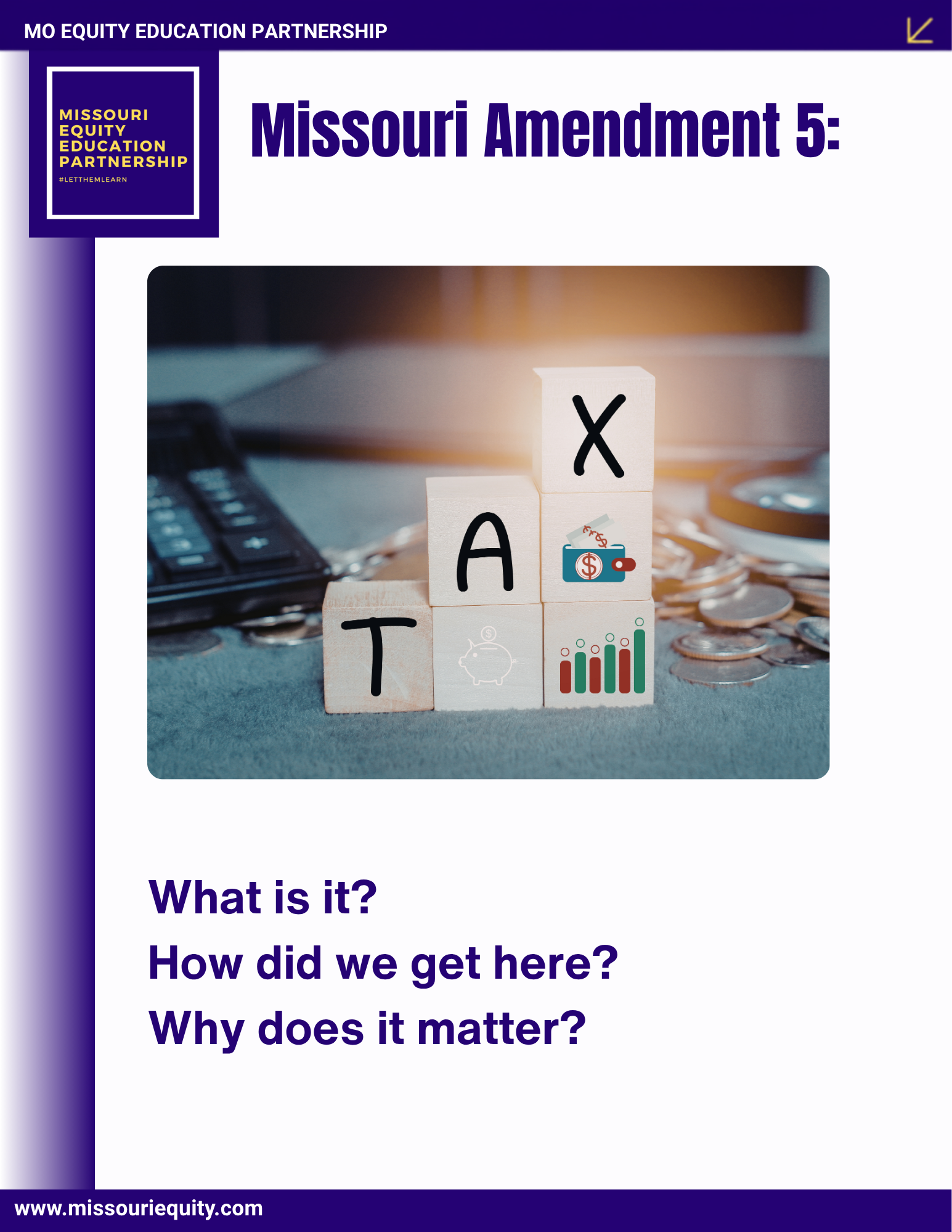
Understanding Missouri Amendment 5
A plain-language guide to the constitutional amendment on your primary ballot: what it proposes, how Missouri got here, and what's at stake — so you can vote from an informed position.
August 4
PRIMARY ELECTION DAY
July 8
REGISTRATION DEADLINE
$8.5 Billion
INCOME TAX REVENUE AT ISSUE
Permanent
CONSTITUTIONAL CHANGE
THIS TOOLKIT ANSWERS THREE QUESTIONS:
FIRST
What is it?
The exact ballot language, what a yes or no vote does, and what the amendment would actually change.
THEN
How did we get here?
A decade of incremental income-tax cuts that set the stage for this proposal.
FINALLY
Why does it matter?
The exact ballot language, what a yes or no vote does, and what the amendment would actually change.
WHY THIS TOOLKIT MATTERS:
A ballot question with generational consequences, written in language most voters never see before election day.
Amendment 5 would amend the Missouri Constitution to phase out the individual income tax and authorize an expansion of sales and use taxes. Because it's a constitutional change, it can't be undone by the legislature alone — only another statewide vote could reverse it. Primary turnout is typically low, which means each vote carries more weight.
The Missouri Equity Education Partnership built this toolkit to put the full picture in one place: the official ballot text, the history behind it, the case supporters make, the case opponents make, and the independent fiscal analysis — so you can weigh it for yourself.
WHAT’S INSIDE
01 — The Basics
What Amendment 5 is
Its origin as HJR 173/174, the legislative votes that placed it on the ballot, and the legal challenge over its summary.
02 — The Text
Actual ballot language
The official wording from the Secretary of State, plus what a "yes" and "no" vote each mean.
03 — The Mechanics
What it would actually do
The four major changes: phasing out the income tax, expanding sales taxes, adjusting local taxes, and removing prior protections.
04 — The History
How we got here
A decade of income-tax cuts from 2014 onward and the revenue picture they created.
05 — Both Sides
The arguments for and against
The case supporters make for tax relief and competitiveness, alongside the concerns opponents and independent analysts raise.
06 — The Stakes
Services and budget impact
How schools, public safety, health, and local services could be affected, with the fiscal analysis behind each claim.
07 — Your Part
How to get involved
Registration deadlines, voting options, and concrete ways to learn more and make your voice heard.
08 — The Receipts
Full source list
Every figure and claim is cited to public records, news reporting, and fiscal analysis you can check yourself.
STRAIGHT FROM THE BALLOT
What you'll actually see on August 4
Shall the Missouri Constitution be amended to:
Require legislative phase-out of the individual state income tax based on revenue growth, and authorize the expansion of sales and use taxes;
Curtail constitutional limits on taxing goods and services; and
Require local tax rate cuts without reducing school funding if local sales tax revenue increases?
A "Yes" vote
Amends the constitution to require the phase-out and elimination of the individual income tax based on revenue growth, and authorizes expanding sales and use taxes.
A "No" vote
Leaves the constitution unchanged: no required income-tax phase-out and no new authorization to expand sales and use taxes.
Per the official summary, the proposal has no direct impact on state or local tax revenue; any implementing legislation would have an unknown impact.
Source: Missouri Secretary of State — sos.mo.gov/petitions/2026ballotmeasures
"In Missouri, the fight for education is not theoretical — it is lived, contested, and deeply political. MOEEP stands at the intersection of community knowledge and policy power."
— Heather Fleming, Founder & Executive Director, MOEEP
This toolkit is provided by the Missouri Equity Education Partnership for general educational and informational purposes only. It reflects our organization's analysis and viewpoint and does not constitute legal, financial, or tax advice; readers should consult a qualified professional before making decisions based on its contents. While we strive for accuracy using publicly available sources, we make no warranties regarding the completeness or current accuracy of the information, and we disclaim liability for any actions taken in reliance on it.